
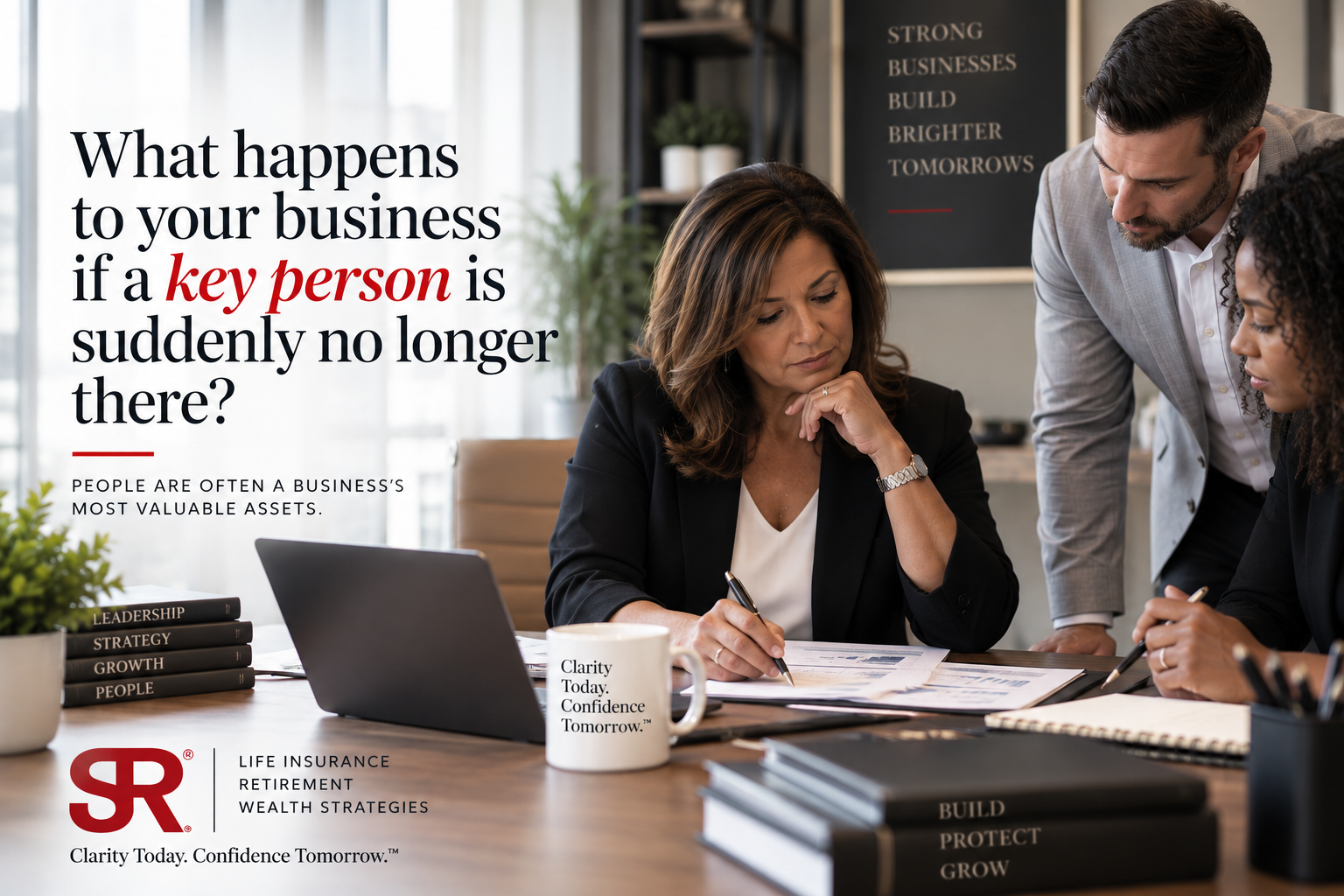
Life Insurance Is Not Just Personal:
What Business Owners Should Know
Building a successful business takes years of hard work, but the people behind that business
may be among its most valuable assets.
The question is whether your business is prepared if one of those people are suddenly no longer there.
By Staci Redmon | Retirement Confidence Advisor™
September 2026 • 7 min read
When most people hear the words life insurance, they immediately think about protecting their spouse, children and family. Those are certainly important reasons to have life insurance, but if you own a business, the conversation can be much bigger. You also have a business to protect, employees who may depend on you, key people who help keep the company running, financial obligations that do not disappear when someone dies, and eventually your own retirement to think about.
I learned some of this firsthand as a business owner, long before I became a licensed insurance professional.
I Learned About Key Person Insurance From My Bank
When I owned my business, we had a bank line of credit that helped support our operations. As part of that lending relationship, I was required to have key person life insurance. At the time, I really looked at it as another requirement from the bank. I needed the line of credit, the bank required the insurance, and therefore I needed to get the insurance.
Looking at that experience today, I understand the bank's concern much differently. The bank was lending money to the company, but it also understood that the company's ability to repay that money depended, in part, on the people running the business. If something happened to a person who was critical to the company's operations, revenue or customer relationships, the financial impact could be significant.
That raises a question I think every business owner should consider: What would happen to your business if you or one of the people your company depends on did not come back to work tomorrow?
We Insure Our Business Assets, But What About Our People?
Business owners understand the importance of protecting assets. We insure buildings, vehicles, equipment, inventory and other property because we know replacing those assets after a loss could be expensive.
What we sometimes overlook is that some of the most valuable assets in a business are people.
Think about your own company. Maybe there is one salesperson who manages several of your largest accounts. Perhaps you have an operations manager who understands processes that no one else fully understands. Maybe you have a technical employee with specialized knowledge that would take months to replace. For many small businesses, the key person is the owner.
If one of those people died unexpectedly, there could be an immediate financial impact. Revenue could decline. Customers might become concerned. The company might need to recruit and train a replacement. Existing employees could have to assume additional responsibilities. The business may also need additional working capital while everyone adjusts.
Key person life insurance is one tool businesses can use to help manage that risk. In a typical arrangement, the business purchases a life insurance policy on someone whose death could cause a significant financial loss to the company. The business generally owns the policy, pays the premium and receives the death benefit.
That money can give the company something incredibly important during a difficult transition: time and liquidity.
Key Person Insurance Is Not Automatically a Tax Deduction
This is an important distinction because there is a lot of information online about the tax advantages of life insurance, and not all of it applies to every situation.
When a business is directly or indirectly the beneficiary of a life insurance policy, the premiums generally are not deductible as a business expense. There are also specific federal tax requirements associated with employer owned life insurance.
The purpose of key person insurance is therefore not simply to generate a tax deduction. It is primarily about managing the financial risk associated with losing someone who is important to the business.
That is different from some of the other ways employers may use life insurance.
Life Insurance Can Also Be an Employee Benefit
One of the things I remember learning while studying for my insurance licenses was the favorable tax treatment that may be available for certain employer provided life insurance benefits. This is another area that I think small business owners should understand because life insurance does not always have to be viewed simply as an individual product.
Under current federal tax rules, an employer can generally provide up to $50,000 of qualifying group term life insurance coverage to an employee without the cost of that coverage being included in the employee's taxable income. Different rules apply when coverage exceeds $50,000, and there are additional considerations involving owners, key employees and plans that favor certain employees.
The details matter, but I think there is a larger conversation here for business owners. When you are thinking about compensation, recruiting and retaining employees, are you looking only at salary? Or have you considered what benefits you can provide that may help employees protect their families while also becoming part of the overall compensation package you offer?
For small businesses competing with larger employers for talent, that can be an important question.
What About the People You Really Cannot Afford to Lose?
There is also a difference between providing a benefit to employees and developing a strategy specifically for key employees or executives.
Many business owners have one or two people they really want to keep. It might be the employee who has been with you from the beginning, someone you are grooming to eventually run the company, a rainmaker responsible for a significant amount of revenue or an executive whose departure would create a serious problem.
There are life insurance strategies that can potentially be incorporated into executive compensation and retention arrangements. Depending on what the business is trying to accomplish, these might include executive bonus arrangements and other employer sponsored strategies.
This is where I believe business owners should resist the temptation to start with a product. The first question should not be, "What kind of life insurance should I buy?" The first question should be, "What problem am I trying to solve?"
Are you trying to protect the company if a key employee dies? Are you trying to provide a benefit to employees? Are you trying to retain an important executive? Those are different objectives and may require very different strategies.
Business Partners Need a Plan Too
If you own a business with someone else, there is another uncomfortable but necessary conversation to have. What happens to your ownership interest if you die?
Without proper planning, your family could suddenly inherit an ownership interest in a company they never intended to operate. Your business partner could find themselves running a company with your spouse or children as their new business partners. Your family might want the value of your interest in cash while the surviving owner wants to continue operating the company.
A properly structured buy sell agreement can establish what is supposed to happen when an owner dies, and life insurance may be used as a source of funding for that agreement.
The insurance does not replace good legal planning. It can, however, provide the money needed to carry out the plan.
Business Owners Need Personal Protection Too
There is something else I understand much better after having owned businesses myself. Business owners have a tendency to put an enormous amount of money, time and energy back into their companies.
There is always something else the business needs. Another employee. Another piece of equipment. More inventory. Marketing. Technology. Working capital. Another opportunity for growth. It is very easy to convince yourself that investing in the business is also investing in your future.
Sometimes it is. But your business and your personal financial plan are not necessarily the same thing.
If something happened to you, would your family have enough personal life insurance, or would most of their financial security depend on what happens to the business? If you lived a long life and eventually wanted to retire, would you have assets and income outside of the company, or would your entire retirement plan depend on selling the business?
Those are questions worth answering while you still have time to make choices.
Protecting What You've Built Means Looking at the Whole Picture
When I talk about protecting what you've built, I don't mean simply buying an insurance policy. I mean understanding where the risks are and deciding which ones need to be addressed.
For a business owner, that can mean protecting the company against the loss of a key person. It can mean providing benefits that help protect employees and their families. It can mean creating a strategy to retain important people. It can mean making sure business partners have a plan if one of them dies. It can also mean making sure that after spending years building a company, the owner has built something for his or her own family and retirement as well.
If you own a business, here are five questions I think are worth sitting down and answering:
What would happen to my company financially if I or one of my most important employees died tomorrow?
Do I know which people in my organization would be difficult or expensive to replace?
Am I using employee benefits strategically, or am I thinking about compensation only in terms of salary?
If I have business partners, do we have a current plan for what happens to our ownership interests if one of us dies?
Am I building financial security outside of my business, or am I counting on the business itself to provide my retirement?
You may answer those questions and discover that your current planning is exactly where it needs to be. You may also uncover an area you simply have not thought about in a while.
Either way, that is where good planning begins.
If you're a business owner and it has been a while since you looked at how your business, employees and family would be affected by the loss of an owner or key employee, I would be happy to have that conversation with you. We can start by looking at what you already have, what you're trying to protect and whether there are any gaps that deserve a closer look.
Clarity Today. Confidence Tomorrow.™
Staci Redmon
Retirement Confidence Advisor™
This article is for educational purposes only and is not intended to provide tax, legal or accounting advice. Tax treatment and insurance strategies vary based on the type of business, plan design, policy ownership, beneficiary arrangements and individual circumstances. Please consult the appropriate tax and legal professionals regarding your specific situation.